Tuesday, April 7, 2009

On Rick Mercer and being 'Torontarded'...


The following rant was taken from Rick Mercer's online blog...

Canadians love to talk about the weather - always have, and always will. It's what we do. We have always been passionate about the weather, but we have never been hysterical about the weather, and certainly we have never been afraid of the weather. But suddenly, that seems to be changing.

Now first, I thought this was a Toronto thing. Because when you move to Toronto you realize pretty quick that when it comes to the weather there are two parallel universes. There's what you hear about in the media, and then there's what you see out your window. You can wake up and turn on the news and you can see a lead story about a snow storm that slammed the city, how there were three-hundred accidents between 5 and 9 AM, how no flights took off. And the reporter on the scene is so panicked he sounds like he's reporting live from the bottom of a collapsed mine shaft.

And you think, "Oh my God, I had no idea, those poor people." But then you realize: hang on, I'm in Toronto, then you look out the window, there's three centimetres of snow on the ground and the kid across the street is walking his dog in his T-shirt. And you realize, there was no snow storm. There was no weather bomb. There were flurries. And then, it got windy and then the entire city ground to a halt.

It's why I invented the word "Torontarded." Good word, comes in handy, believe me. But before the rest of the country gets all cocky, know this: weather hysteria is spreading across this nation like some sort of demented low pressure system.We don't have forecasts anymore - we have weathertainment. And it's all designed to scare the hell out of you.

Cold weather and snow is now reported like a plague of locusts or raining frogs. Problem is, it's not a sign of a coming apocalypse - it's just business as usual in Canada. But tell that to the crowd at the Weather Network. You listen to them for five minutes, you wouldn't leave the house for five months.

This is the true north strong and free, and cold, and wet, and icy, and dark - sometimes all at once. It's why God invented long johns. This is Canada. We have winter. Life sucks, get a toque. And embrace it.

http://www.rickmercer.com/blog/index.cfm/2007/12/5/Weather-Nation

Rick Mercer, truly the funniest man on TV these days.

Thursday, April 2, 2009

On customizing 'Baby'...


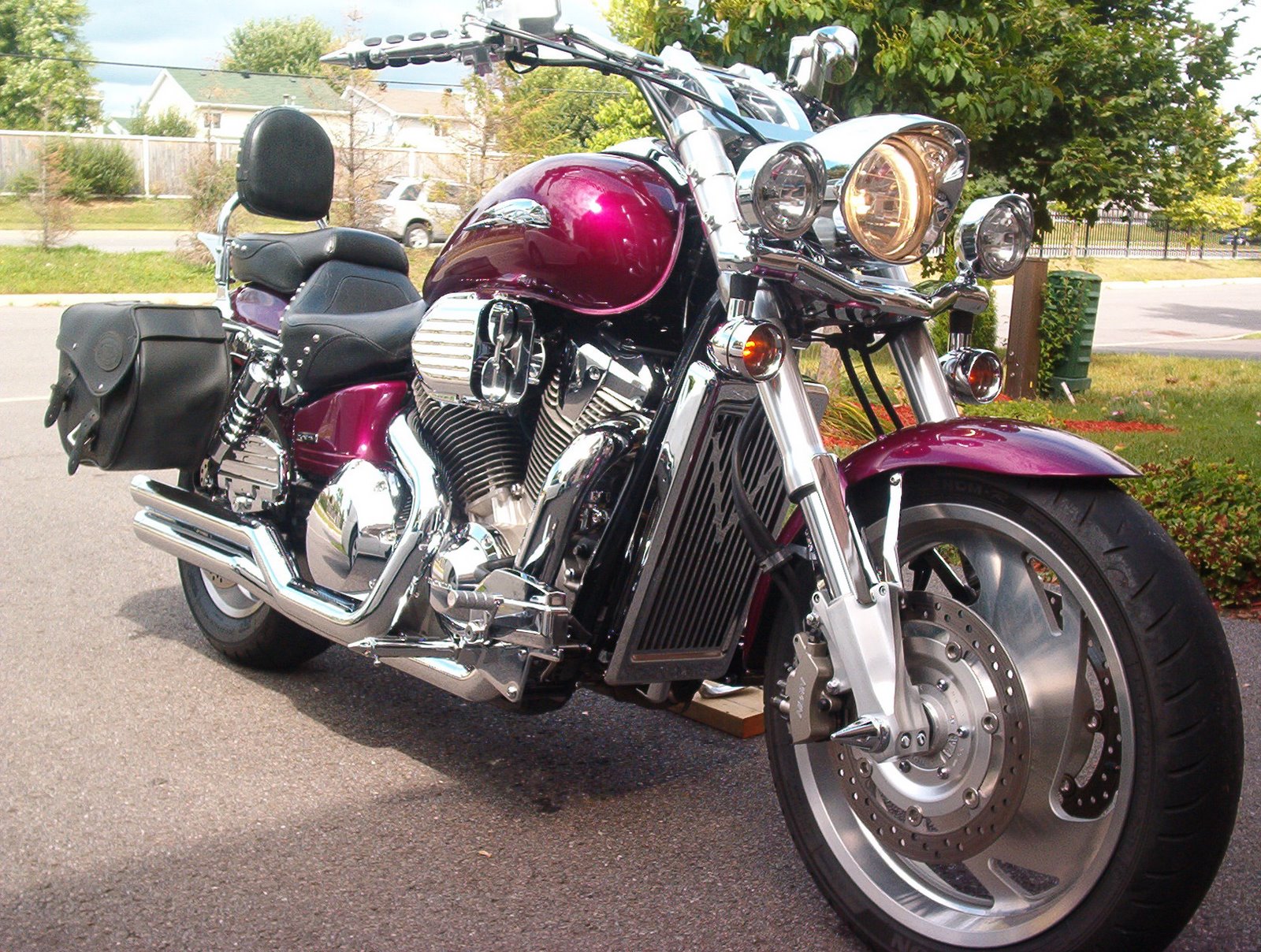
Since I first signed the papers for Baby, back in July of 2005, I have spent a few dollars in 'extras' on her. These were mainly for 'big ticket' items such as a new set of Vance & Hines pipes (for the engine to breathe out better), a new studded 2-up Mustang saddle (to take care of my back), K-Drive saddlebags (for travelling), a matching studded backrest (for my passenger's safety and comfort), a Scorpio alarm system (for security and lower insurance premiums), a KuryAkyn Hypercharger air system (for the engine to breathe in better), Aeromach 2-inch custom risers (for less stress on my back from reaching for the bars), KuryAkyn grips, pegs and passenger floorboards (again, comfort and security).

The Memphis Shades windshield came a little later on but was also a considerable expense, as I used a smaller one first, only to find it ineffective when riding 2-up. So I had to move up to a bigger (and more expensive...) Memphis Fats model. These greatly reduce wind-induced fatigue, road noise and buffeting, to say nothing of deflecting rocks, road dirt, insects and whatever else is airborne at the moment.

The Big Bike Parts radiator cover? That's simply insurance against damage from road shrapnel. I have yet to manufacture and install a metal guard plate for the plastic radiator coolant reservoir, located underneath the bike. One hole in this and you're pretty much screwed on the open road... The Progressive Suspension 412 shocks replaced the thoroughly unsatisfactory stock rear shocks and smoothed out the ride for both of us. Finally, the Big Bike Parts passing lamps are there for safety considerations (being seen and being able to see).

Recently, other than the new set of Avon Cobra tires I have ordered for my ride, it has truly been some time since I have spent any money on her. Other than gas, oil, filters and maintenance, of course. I believe the last item I graced her with, was that Mustang studded leather tank bra. Very chic... That was purchased over a year ago. I will deliberately not count the expense for bringing her back to rights after our little misadventure last July. Even the KuryAkyn forward control extensions, were simply a minor reward for having survived the fray. Those were necessities, not niceties. There are a myriad of items out there, both from the manufacturer and the aftermarket industry, which have been specifically crafted (or slapped together, in some instances...) for my make and model of bike.

Now "just because they make it", may be a reason for some folks to hurry out and buy items for their ride. That's okay, too. More power to them. Eventually you're gonna run outta room for 'stuff' and your pride and joy just might begin to look more like a rolling rummage sale. Still, there are folks who actually enjoy doing this and they can actually carry it off. It's a well-known factoid that many riders are not your average run-of-the-mill Joes. They set their own pace, chart their own course and march to the beat of their own drum, whether you can hear it or not. It's one of our more endearing traits...

But I do tend to be a little finicky when it comes to that. There are areas of my ride which have remained suspiciously devoid of 'bling', to coin a strictly ebonic term. But that's only because I look at Baby as a canvass. A large, hulking, beautiful, powerful, moving canvass. I don't know that there's a specific 'look' that I'm aiming for, but I take my time in locating and selecting items which please me. Which I find will look good on her. They virtually have to leap off the page or screen, if they are to get my attention. I do not purchase items based on say-so, or because someone else thinks they would 'look good'. I certainly don't buy anything because 'someone else has it'. That's also probably one of the very good reasons as to why I don't ride a Harley.

This week has seen a minor flurry of buying on my part. All small items. Themselves perhaps not outrageously striking, but taken together... a step closer to providing the finishing touches for my canvass on wheels. For giving her that finished, seamless appearance. The items I have ordered to date this week are as follows:

A chrome driveshaft cover as well as a chrome cover for the driveshaft nuts.

http://www.xtremerevolution.com/Store/showproduct.aspx?siteid=1&productid=1137&CategoryID=95&SectionID=1&gvid=2867

Chrome covers for the real axle nuts, inspection cover and differential drain bolt.

http://www.xtremerevolution.com/Store/showproduct.aspx?siteid=1&productid=8203&CategoryID=96&SectionID=1&gvid=36196

I also purchased a very nice domed, chrome cover for the steering stem nut.

http://www.xtremerevolution.com/Store/showproduct.aspx?siteid=1&productid=139&CategoryID=96&SectionID=1&gvid=320

The rear shock mount bolts will also receive a nice set of chrome covers.

http://www.xtremerevolution.com/Store/showproduct.aspx?siteid=1&productid=341&CategoryID=96&SectionID=1&gvid=857

Small touches... innocuous, really... yet the overall impression will be striking. Eventually I will finish her off with a set of chrome frame covers and a chrome cover for the right-hand side swingarm.

http://www.xtremerevolution.com/store/showproduct.aspx?siteid=1&productid=103&CategoryID=95&SectionID=1&gvid=618

http://www.xtremerevolution.com/store/showproduct.aspx?siteid=1&productid=494&CategoryID=95&SectionID=1&gvid=1238

Is there anything else...? Well, possibly the addition of a small stainless cover to hide the brake line manifold under the bottom triple tree.

http://www.xtremerevolution.com/store/showproduct.aspx?siteid=1&productid=188&CategoryID=96&SectionID=1&gvid=444

And of course a set of chrome fork caps.

http://www.xtremerevolution.com/Store/showproduct.aspx?siteid=1&productid=196&CategoryID=96&SectionID=1&gvid=475

But seriously, that's about it. I don't need any trick mirrors that I can't really see anything out of, or that are the size of a dentists's inspection mirror. I'm not big on having lights illuminating my engine parts or the underside of my bike. My bike is for my enjoyment, not the entertainment of other people. I don't need minuscule turn signals that cars behind or in front of me can't see. I don't need a gimbal-mounted cup holder or even a gps system, although for super long trips, that really wouldn't be a bad addition.

The fine folks at KuryAkyn make a wonderful set of chrome control covers for the handlebar switches, which I may further investigate at some point.

http://www.xtremerevolution.com/store/showproduct.aspx?siteid=1&productid=337&CategoryID=14&SectionID=1

However with that said, the folks at Show Chrome make a real, honest-to-God set, which you install the switches and wiring into. No mere covers here, but the real deal...

http://www.xtremerevolution.com/store/showproduct.aspx?siteid=1&productid=107&CategoryID=14&SectionID=1

They also make a beautiful replacement rear lights/license plate bracket, of which I am quite fond as well.
http://www.xtremerevolution.com/store/showproduct.aspx?siteid=1&productid=66&CategoryID=20&SectionID=1&gvid=60553
All in all, it's about the aesthetics. The form, as well as the function. Does it serve a purpose? Does it work well? Is it well made? Does it look good? Would it 'go'...? These are the questions which run through my mind whenever something does catch my eye.


As the well-worn saying goes: "I may not know art... but I know what I like!"


On the movie: "Religulous"...


Last night we were treated (and yes, that's the proper word to use here...) to a viewing of Bill Maher's "Religulous". It has to be one of the best documentaries I have ever watched. Perhaps that's because I share and applaud Bill Maher's view on the world's religions and where they are leading all of us.

http://en.wikipedia.org/wiki/Religulous

I would highly recommend this movie to anyone, regardless of what faith you profess. In truth, it doesn't matter what faith you claim as your own, because as this film plainly states, they are all man-made, they are all absolute bullshit and they will be responsible for our own self-fulfilling prophecy of destruction.

As with any other movie I have ever seen, I'm not going to bore anyone with what critics' or movie reviewers might have to say. I don't read movie reviews and I actually take offense at those who would promote themselves as 'movie critics'. Like anyone could decide for me "what's worth watching". Gimme a break... I myself thought this movie was very well done and entertaining at the same time. After all... we're talking Bill Maher here... LOL!!

Wednesday, April 1, 2009

New shoes for Baby...


Fighting my seemingly inherent tendency towards procrastination, I finally ordered a new set of tires for 'Baby'. I was pleasantly surprised to discover that Avon (purveyors of wonderfully designed British tyres...), actually markets a 200 series tire for the VTX 1800C. This means simply that the width of the tire is 200mm. The bike comes with a 180 series tire in it's stock configuration. One would think that a tire of this size would be enough...

However in these days of bolt-on 240 series rear end kits and beyond (up to over 300...), the stock 180 tire looks positively anorexic on a bike of this size. As with men's perennial preference in women's backsides, the full, rounded rear end look is still very much "in". Up until only recently, the 200mm tire kit was basically the J-Lo of the bike scene. Then Suzuki introduced the Boulevard M109R, a beast of a cruiser which featured a 240mm rear wheel. In stock configuration! It was the Eva Mendes, nay... the Beyoncé Knowles of cruisers and had the curves to match.

http://www.bikernet.com/news/images/PhotoID20865.jpg

Nowadays, rear end kits are available for bikes in any size up to 320mm. (We're talking Kim Kardashian territory here, fellas...)

http://www.metricfats.com/wp-content/plugins/wp-shopping-cart/product_images/PICT0006.jpg

The major benefit in going a little wider with the rear tire, is simply that it gives the rider more of a 'contact patch' with the road. Sure, it is esthetically more pleasing to the eye as well, but it also enhances the stability and 'planted' feel of the bike. Personally, I couldn't see going any wider than a 240, as I feel there are literally no benefits to be gained from anything wider, unless all you're after is bragging rights. True, there are several conversion kits available for my VTX and other uber-cruiser models, in the 240mm range. These however retail for large amounts of dollars, require structural changes to the rear of the frame (read: chopping off of parts) and also necessitate changing out the rear fender, struts and the saddle. The total cost can top $7,000.00 and that's not counting paint... But holy mother of God do they look sassy...

http://www.xtremerevolution.com/store/images/product/large/1801.jpg

http://www.meancycles.com/images/inventory/glacial/4.jpg

The crux is being able to justify the expense, whether to yourself or your "not-so-understanding" significant other. Unless of course you're one of these poor unfortunates who has entirely too much disposable cash on hand, at any given moment. What would hold me back from such a project, is the fact that there are no 2-up seats made at the moment, for any of these custom fenders which are required to do the conversion. For as much as my better half's interest in riding may very well be waning since my accident, I would be hesitant to convert my ride into a solo cruiser just yet, though that day is no doubt coming.

But I've gone off on a tangent here... (so what's new, right?) I am excited about the prospect of getting this new rubber for Baby. There is nothing finer than a new set of tires. Particularily when your present front tire's contour when looking at it from above, resembles not a smooth arc, but rather a 3-angled valve job. Any tread remaining is now concentrated on the very outer edges of the sidewalls. This signals time to change it out with something a little more, shall we say, utilitarian. This way I won't have to dread the coming of rain, should I be out riding when this occurs.

New tires impart a totally different feel to a bike. It's like when she was brand new again. You'd never get to notice such a difference in a car. With fresh tires, the bike requires no more than a thought to lean into a corner. Steering is a joy. Effortless. It is as though the bike is able to anticipate your movements. The least little contraction of a muscle, the slightest shift of pressure on the grips, will send you sailing off in your intended direction. When cornering, the feeling is solid, safe as you track along the curve's line of travel. Whether the road is dry or wet. The Avons give me this feeling of confidence, of absolute control. They are, in my humble opinion, so much better than the stock Dunlops that come with just about every single bike made in the universe. The Dunnies are shite. You're lucky to get 12,000kms out of a set, regardless of how anal you are in maintaining your tire pressure.

So yes, it is with high anticipation that I await confirmation of my order. I will go down to Ogdensburg, NY to my favorite little UPS Store to pick them up when they arrive. Since motorcycles have only 2 tires keeping them off the road, one learns to pay attention to these. It also seems that the motorcycle industry has reasoned that since we only have 2 wheels, we really oughtta make tires as expensive as possible. After all, it's not like riders are gonna buy 4 tires at a time, so we gotta make our money somehow...

I'll be paying $230.00 (US) for the rear tire and $177.96 (US) for the front one. Yeah, I can hear you cagers (automobile drivers...) out there gasping in horror as you read this. Just think of how expensive they would be if I bought them from a dealer here in Canada!! I'd pay close to $400.00 for the rear tire and over $300.00 for the front one. Then add 14% GST on top of that... Screw them. If you want business from Canadian consumers guys, stop leaning us over your counters and raping us when we try to do business with you. It's really as simple as that... Still, I am very happy about the new tires and the smokin' deal I got on them. God love online shopping and free shipping across all 48 continental States!!


Monday, March 30, 2009

The book PETA doesn't want you to read...


And finally for today:

The Book HSUS and PETA Don’t Want You to Read

The Consumer Freedom interview with Redemption author Nathan Winograd.

Nathan Winograd is a Stanford Law School graduate and a former criminal prosecutor. He has also presided over America’s two most successful experiments in what’s become known as the “No-Kill” animal shelter movement. At SPCAs in San Francisco and Tompkins County, New York, Winograd showed that No-Kill animal sheltering -- the brand of hands-on animal care that deep-pocketed animal “rights” groups like PETA and the Humane Society of the United States (HSUS) ironically oppose -- can work.

In his book Redemption, Winograd argues that the idea of pet overpopulation in America is a myth. PETA cites this “overpopulation” as the reason it
kills nearly 90 percent of the dogs and cats it takes in. And the Humane Society of the United States (HSUS) literally wrote the book on a system of animal sheltering that seems resigned to killing healthy pets out of sheer laziness, instead of looking for alternatives.

After we read Redemption, we had some tough questions for Winograd. And he graciously agreed to answer them.


CCF: Right on the cover of your book, you call the idea of pet overpopulation in the United States a "myth." Are you saying that there are enough homes for every healthy, unwanted pet?


Winograd: Yes. Based on the number of existing households with pets who have a pet die or run away, more homes potentially become available each year for cats than the number of cats who enter shelters, while more than twice as many homes potentially become available each year for dogs than the number of dogs who enter shelters.

Put another way, every year more families are potentially looking to bring a new dog or cat into their home than the animals that enter shelters. And the market of homes (the number of homes which do not currently have a dog or cat but will acquire one) is expanding rapidly. If shelters increased their market share by just a few percentage points, we could be a No Kill nation right now. But we are far from it.


As a movement, the humane community has accepted the idea that the best shelters can do for homeless animals is to adopt out some and kill the rest. To try to avoid criticism for this, to justify a paltry number of adoptions, these groups have perpetuated the myth that there are simply more animals than homes, something that is patently false (even though most people believe it).

Redemption offers a stunning indictment of the Humane Society of the United States (HSUS). Why does such a wealthy animal rights organization appear so disinterested in saving the lives of cats and dogs?

HSUS is the wealthiest humane organization in the United States. Since its founding in the mid-1950s, it has grown in scope, size, and influence. It claims the support of some 10 million members, while its conference which caters to shelters is currently the largest nationwide. Given that, one would predict, expect and hope that it would be at the forefront of the No Kill movement, leading the way to ending the systematic killing of dogs and cats in U.S. shelters. But instead HSUS has been one of No Kill’s fiercest and most obstinate opponents.

One of the fundamental downsides of bureaucracies is their focus on self-preservation at the expense of their mission. Agencies like the Humane Society of the United States have ignored No Kill success and put the interest of animals -- indeed their very lives -- aside.

What would HSUS stand to lose if American animal shelters all moved toward a “No Kill” philosophy tomorrow?

Other than a few employees with a deplorable history of supporting the unnecessary killing of dogs and cats in shelters, and perhaps some longstanding relationships with shelter directors mired in killing, absolutely nothing. In fact, they would be hailed as pillars of compassion by the American public. That is what makes their position on this issue (historical and presently) so disturbing.

If you had HSUS's resources ($200 million in the bank and $150 million of income this year), how much progress could you make toward reforming our nation's animal shelters? What would you do first?
More money isn’t necessary to end the killing of savable dogs and cats in shelters. In fact, most of the programs and services necessary to save lives would actually cost these shelters less than what they are currently spending to warehouse animals and then kill them.

For example, adoptions generate revenue, they generate good will (which could be leveraged for future donations), and they lead to greater word-of-mouth publicity which leads to more adoptions and more revenue. Killing animals, by contrast, not only costs money (to end an animal’s life and dispose of the body), but it also makes the public less satisfied with the job a shelter is doing, especially as the shelter blames that same public for the problem. These are the people a shelter needs to embrace (in the form of adopters, volunteers, and donors) if it’s going to save animals’ lives.


Volunteers and foster homes also provide subsidized services, in which private individuals and rescue groups care for shelter animals at no cost to taxpayers. It is a cost-free way to save a great number of dogs and cats. But too many shelters turn these people away at the front door -- while the animals they are trying to help go out the back door in a body bag.

In short, animals are not dying because of lack of money in the vast majority of U.S. cities.


Take the municipal animal shelter in Austin, Texas for example. In 2000, its budget was $2.9 million. Now it’s $4.8 million. But the number of dogs and cats killed in Austin increased during this time. PETA spends around $30 million every year, but claims it can’t save 2,000 dogs and cats. Following the devastation of Hurricane Katrina, Americans donated over $32 million to the Humane Society of the United States, specifically to help the dogs and cats trapped in New Orleans.

They spent only a fraction of that money on the problem. What did they do with the rest?You have a pretty blunt assessment of PETA's long-standing habit of killing animals instead of working to place them in adoptive homes. Why should the public believe PETA's line about saving pigs and chickens if it's not willing to start with dogs and cats?

This, to me, is the great betrayal in PETA’s position. If groups like PETA openly champion the killing of dogs and cats in shelters, if they do not take the position that killing dogs and cats is inherently unethical and should be condemned, how do they expect to convince the public that pigs, chickens, and other animals -- with whom Americans do not have a close relationship -- should have more protections?

If the animal rights community, which claims to be the standard bearer for what our relationship with animals should be, approves of the idea of killing millions of animals in shelters, doesn’t that undermine their ultimate goals? The old adage “With friends like these, who needs enemies?” could not be more true.

What's beneath the surface of PETA's apparent hypocrisy here? Why do you think the group doesn't endorse a “No Kill” philosophy, or at least stop tasking its employees with killing pets?I can only think of one possibility. PETA’s founder, Ingrid Newkirk, previously worked at the Washington Humane Society in Washington, DC, a shelter that has historically been the subject of public criticism for high rates of shelter killing.

In fact, at a time when Stanford University was having great success with its program to save homeless cats on its campus, the Washington Humane Society opposed my effort to create a similar program on the Georgetown University campus. In the end, Georgetown sided with the Washington Humane Society, which embraced a campaign of extermination.

Few animal activists who follow PETA’s lead on the companion animal issue are probably aware that its founder’s former job was to kill homeless dogs and cats in a shelter that had a poor record for saving lives.

Isn't it a bit hypocritical for groups like PETA and HSUS to be front-and-center in the Michael Vick story?

Nobody with half a brain supports dog fighting, but isn't killing dogs out of sheer convenience just as nasty?

The thought of what those poor dogs went through is personally very painful to me. If the public pressure created by these groups led to Vick’s suspension from the NFL, a positive thing has been accomplished. If it leads to greater penalties for people who do this, again that is positive. And as a former Deputy District Attorney who prosecuted animal cruelty cases, I believe that if Michael Vick is found guilty, he should be punished severely.

But while PETA applauds the prosecution of Michael Vick, it fought similar efforts by a prosecutor in North Carolina who went after PETA employees for needlessly killing animals and dumping their bodies in supermarket trash bins.

And while PETA condemns Michael Vick for killing Pit Bull-type dogs, PETA itself is on record saying that each and every Pit Bull entering a U.S. animal shelter should be killed as a matter of policy -- including healthy and friendly dogs. By its actions, words, and deeds, PETA is condemning hundreds of thousands of dogs annually to death.

HSUS is no better. HSUS once called the mass extermination of alley cats the only “practical and humane” solution. Why is the needless killing of millions of cats “humane,” especially in the face of non-lethal lifesaving alternatives?

In your book, you mention briefly the connection between shelter adoption rates and retail pet sales. Can you flesh this out a bit? Does this indicate that there are plenty of homes for adoptable animals?

When San Francisco became the first city in the U.S. to save all healthy, homeless dogs and cats, and was effectively talking to the public about pet adoption, there was not a single pet store left in the city selling dogs and cats. It didn’t start out that way, but that was the result. Why? Because they couldn’t compete with the SPCA.

Americans want to do the right thing, and they saw shelter adoption as a way to save lives and bring the joys of animal companionship into their homes. By contrast, when you look at cities with high levels of shelter killing, you also tend to see large numbers of pet stores.

This tells me that the animals in these communities aren’t dying because “there are too many dogs and cats, and not enough homes” -- as the shelter directors want you to believe. If that were the case, you wouldn’t see so many pet retailers. They exist because there’s a market demand for dogs and cats. And because the shelters are doing a lousy job at adopting to the community.

You make a pretty convincing case that whatever pet "overpopulation" exists in the U.S. is the fault of poorly run shelters, not the public that typically gets blamed for creating the problem. But surely there's something the public can do to help reverse the current situation. What's your bottom-line advice for John Q. Consumer?

We need to reclaim these institutions. The agencies that the public expects to protect homeless pets are instead killing more than five million of them every year. Lifesaving alternatives have existed for decades. But too many of these agencies remain mired in the “kill” philosophy of the past, unwilling to explore and adopt methods that save lives. This is a breach of their public trust.

We need to reform animal shelters through lobbying, by making demands at the local government level, and by withholding contributions until they change. We need to hit them right back for advocating killing by using a tactic they understand: the boycott.

Do not donate to HSUS or any other shelter or agency which refuses to embrace a No Kill philosophy. Let them know that when they decide to do right by the animals, you will be ready to open your checkbook.

In the end, there may be an overpopulation problem in the United States, but it is not the one we traditionally define. What we are actually suffering from -- what is actually killing a high number of animals -- is an overpopulation of lazy and complacent shelter directors.

A culture of lifesaving is not possible without wholesale regime change in shelters, and in national animal protection groups. So the most important single act -- and the crucial first step -- is to fire the current leadership of shelters across the country. That is what the public should demand.

Redemption: The Myth of Pet Overpopulation and the No Kill Revolution in America is
available online from Amazon.com and other retailers. Every copy sold is guaranteed to raise the blood pressure of the wrong-headed activists who run PETA and HSUS.


HSUS activists torture seal...


Wednesday, January 30, 2008

HSUS Activists Torture Animal For Promotional Video

© By Othmar Vohringer

Members of the Humane Society of the Untitled States (HSUS) were caught on video by Pro-seal hunt filmmaker Raoul Jomphe as they contributed for hours to the suffering of a badly injured seal for a promotional video. According to the Ottawa Citizen:

“…the animal rights activists pulled the dying seal out of the water as it tried to escape, and continued filming their promotional video. It is not known how the seal was wounded.” Raoul Jomhe said.

"If I had been on the ice with my family and kids, I would have told them to turn around, and I would have killed the seal myself, because it was disturbing for me to see that. "To me this is just another piece of evidence of what I have known all along. Animal rights activist groups such as the HSUS and PETA are hypocritical. While they try to maintain the cuddly animal loving face in public behind the scenes they are among the cruelest animal abusers.

This is not the first documented case of animal rights activists purposely abusing animals to gain promotional film footage that they than use for their knee jerk propaganda. To learn more about the animal rights and their continued animal abuse I recommend these two reliable resources. AnimalRights.net (Exposing the animal rights movement) and PETA Kills Animals an affiliate organization of the equally recommended ActivistCash.com

Updated by Othmar Vohringer on March 30, 2008

It seems that the above event is not a first for them either. They staged an identical event 4 or 5 years ago. In another example they had an article written that appeared in several papers wailing about the record slaughter of seals that year, describing the horrors they had seen, the blood, the cruelty. The problem? There hadn't BEEN one. The event was canceled and postponed. They didn't know, hadn't been there. The article was made up. In another case, footage of sheriff department and vets darting tigers in a trailer was edited and a voiceover stated it was a "canned hunt". HSUS again. Want to bet this footage turns up soon on network and cable TV?

Without a mention of it being staged?

(I'd bet my life on it... - Crypt.)

YES, the HSUS kills puppies...


HSUS, PETA Hypocritical on Animal Cruelty
September 11, 1997

St. Paul, MN -- Fur Commission USA has blasted the Humane Society of the United States (HSUS) and another national animal rights group as "hypocritical and highly selective in their condemnation of cruelty to animals." The criticism is in response to HSUS demands that three 18-year-old boys in Fairfield, Iowa be sentenced to up to ten years in jail for killing stray cats.

"Animal cruelty is a serious matter wherever it occurs," said Commission President Skip Lea. "But the HSUS has been hypocritical and highly selective in its condemnations. More than 5,000 mink have been killed by animal rights criminals attacking fur farms in the U.S. We've heard no calls for jail time for the perpetrators of these crimes. Where is the HSUS outrage over these animal deaths?"

Lea said animal cruelty is unacceptable, regardless of the source. "When animal liberationists drive farm-raised mink to a bloody death on a busy highway or between the jaws of a predator in the wild, they are guilty of an unconscionable act of animal cruelty, and should be prosecuted to the full extent of the law," he declared.

As an example, Lea cited the death of 500 adult female mink and 2,000 newborn kits after an ALF raid on an Oregon farm in May. According to a June 2 Associated Press report, a sheriff's deputy at the scene said, "We're kind of upset just because of the destruction of the animals and the carnage. One officer couldn't handle it. He had to be excused."

Leading animal rights groups such as HSUS and People for the Ethical Treatment of Animals (PETA) have failed to condemn such actions, Lea noted. PETA materials have described the ALF as an "army of the kind." In fact, PETA's 1994 tax returns show a $45,000 contribution to the Rodney Coronado Support Committee in Tucson, Arizona. Coronado is a convicted ALF arsonist now serving a five-year sentence in federal prison for animal rights crimes. "If that doesn't imply support for animal rights crimes, I don't know what would," Lea said.

Most states have laws that prohibit animal cruelty. Many have statutes to protect farms and research facilities from animal rights terrorism. Lea said both types of laws are being invoked to prosecute animal rights criminals who remove furbearing animals from farms.

"The bottom line is that animal rights terrorism is cruel to animals and humans alike," Lea said. "Animal rights criminals have proved that they don't really care about animals at all. Their goal is to inflict maximum economic damage, no matter the cost to animals or people. After seeing the horrific consequences of ALF raids in the U.S., no rational person could continue to believe this movement is about animal welfare.

"If PETA and HSUS are truly concerned about animal cruelty, they should strongly and publicly condemn any ALF actions that result in the death of animals," Lea concluded.

© 1998-2009 Fur Commission
USA